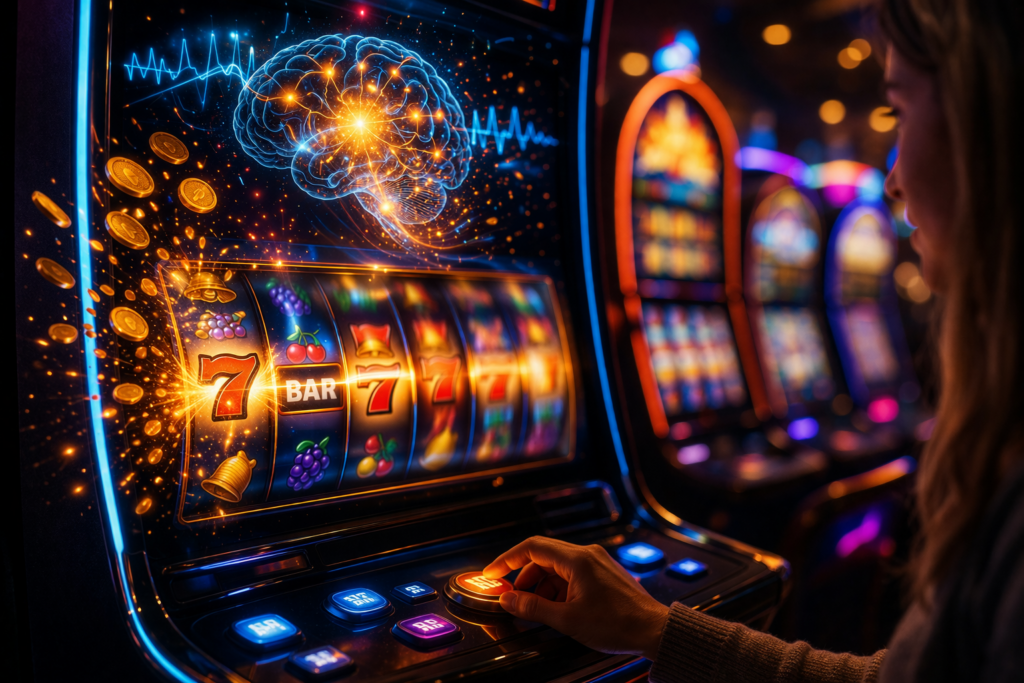
B.F. Skinner didn’t design slot machines. But the behavioural framework he developed in the 1950s (variable ratio reinforcement) describes exactly how they work. Rewards delivered at unpredictable intervals produce the most persistent behaviour. Not frequent rewards. Not large rewards. Unpredictable ones.
That’s the core mechanic. Everything else is layered on top.
Regulated platforms are required to disclose return-to-player percentages, but the number itself doesn’t capture what makes the format psychologically sticky. In this context, http://kult-casino.com/ publishes RTP figures and game mechanics transparently. A 96% RTP tells you the long-run average. It says nothing about the experience of chasing it. Modern slots are built on decades of psychological research, player behaviour data, and iterative design testing.
Near misses are not accidents
The near-miss effect is one of the most studied phenomena in gambling psychology. When two matching symbols land and the third stops one position short, the brain processes that outcome closer to a win than a loss. Physiological markers (heart rate, skin conductance) spike in ways that mirror actual winning responses.
Game designers know this. Reel weighting is configured so near-misses appear more frequently than pure probability would produce. This is legal in most jurisdictions as long as the overall RTP remains accurate. The near-miss doesn’t affect the payout but it significantly affects the decision to keep playing.
UK Gambling Commission research documented this pattern extensively. Finnish regulatory discussions have referenced similar findings as the market moves toward reform.
Losses disguised as wins
Another mechanism that doesn’t get enough attention: multiline slots allow players to bet across twenty, thirty, sometimes a hundred paylines simultaneously. A spin costs €1 total. Three lines pay out, returning €0.40. The machine celebrates – sounds, animations, flashing lights. The net result is a €0.60 loss, but the presentation frames it as a win.
These are called “losses disguised as wins” in the academic literature. They extend session length. Players report feeling like they’re winning during sessions where they’re actually losing steadily. The subjective experience and the financial reality diverge completely.
What Finland’s regulatory shift means
Finland is moving toward a multi-licence gambling model, with legislation expected to reshape the market significantly. One likely outcome is stricter requirements around slot design like mandatory loss notifications, spin speed limits, and restrictions on autoplay features that remove active decision-making from the process.
Sweden introduced similar measures in 2019. The data from that reform showed reduced session lengths and lower average deposits among affected player segments. The psychological architecture of slots didn’t change but friction inserted at key points interrupted the automatic quality of play that makes the format so consuming.
Understanding the mechanics doesn’t make anyone immune to them. But it shifts the dynamic from passive absorption to something closer to informed engagement which is probably the most realistic outcome regulation can aim for.