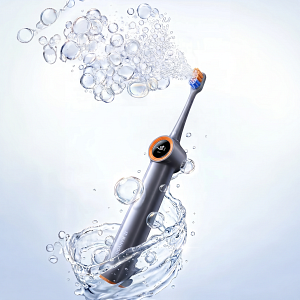
A deep dive into the 20-patent microbubble system that cleans between teeth using physics borrowed from sharks, Venturi tubes, and industrial ultrasonic cleaning.
If you’ve followed the electric toothbrush market over the past decade, you know the script. Each year brings a new flagship: higher vibration frequency, a redesigned bristle pattern, an app that maps your brushing in real time, a subscription plan for replacement heads. The packaging changes. The underlying mechanism — bristle strikes surface, friction removes plaque — does not.
RANVOO, a company that has quietly accumulated 20 granted patents around a technology platform called AirJet 2.0, has decided to break the script entirely. Its AirJet X5 electric toothbrush is built on the premise that the bristle-first model of oral care hit its ceiling long ago. The replacement: fluid dynamics.
The claim is not incremental. It is architectural. And it raises a question worth taking seriously: what if the next breakthrough in personal health tech isn’t about doing the same thing faster, but about doing something else entirely?
The Geometry Problem No One Talks About
To understand why AirJet exists, you have to confront an uncomfortable fact about your current toothbrush — regardless of brand, price, or motor type.
The average human mouth contains 28 to 32 teeth, each with multiple surfaces. Bristles can reliably contact roughly 60% of the total surface area: the cheek-facing buccal surfaces, the tongue-facing lingual surfaces, and the biting occlusal surfaces. The remaining 40% — the interproximal surfaces where teeth touch each other — form narrow vertical channels that bristles are physically too wide to penetrate.
The clinical consequence is stark: over 80% of dental caries originate in these interdental spaces. Not on the broad, brushable surfaces. Not where your premium sonic toothbrush spends two minutes vibrating at 40,000 strokes per minute. Between teeth. Where bristles never go.
This is not a controversial finding. It’s dental textbook material. The controversy — if there is one — is that an industry generating billions in annual revenue has spent decades optimizing a mechanism that, by geometric definition, cannot address the primary locus of disease.
Replacing Contact With Flow
RANVOO’s response is to stop trying to insert a solid object into a space too narrow to receive it. Instead, the AirJet system uses a liquid-gas mixture — a microbubble suspension — as its cleaning medium. Fluids, unlike bristles, conform to available geometry. They flow into gaps without needing to be aimed. They find their own path.
The technology stack breaks into three stages:
Stage 1 — Generation. Inside the toothbrush handle, a Boosted Bubble Chamber uses a Venturi-type aerator to shear the water-toothpaste mixture into a high-density stream of microbubbles. Each bubble measures tens of microns in diameter — small enough to enter interdental spaces, stable enough to survive the journey. This is not the coarse foam that forms when any brush agitates toothpaste. It’s an engineered suspension, produced at up to 1,000 milliliters per minute in the device’s signature Bubble Mode.
Stage 2 — Guidance. The brush head is shaped using computational fluid dynamics simulation to exploit the Coanda effect: the principle by which a fluid jet adheres to and follows a curved surface. When the microbubble stream exits the head and contacts a tooth, it wraps around the contour rather than dispersing. It naturally flows into the nearest interdental opening. The user brushes with normal motion. The geometry handles targeting.
Stage 3 — Cavitation. This is where the engineering gets genuinely interesting. When microbubbles reach the confined space between teeth and contact plaque biofilm, they collapse asymmetrically. This is acoustic cavitation — the rapid implosion of a bubble near a solid boundary, producing a high-velocity microjet directed at that surface. Each collapse generates sufficient shear stress to disrupt the extracellular matrix that binds plaque to enamel.
The mechanism is the same one that powers industrial ultrasonic cleaning tanks, where cavitation bubbles strip contaminants from machined parts. RANVOO’s innovation was in energy calibration: tuning the effect to oral-safe levels while preserving cleaning efficacy.
What a Shark Has to Do With It
In perhaps the most unexpected detail of the AirJet engineering story, RANVOO’s team modeled the brush head’s oscillation pattern on a piece of marine biology: the reverse Kármán vortex street.
When a great white shark sweeps its tail, it sheds counter-rotating vortices into its wake. Unlike a bluff body in a flow — which generates a drag-producing Kármán vortex street — the shark’s tail motion reverses the rotation, converting the vortex train into a thrust-generating structure. It’s one of nature’s most efficient propulsion mechanisms.
The AirJet X5’s vibration frequency and oscillation amplitude are coupled to produce a similar effect in the fluid environment of the mouth. Each micro-oscillation becomes a directional pulse that drives bubble-laden fluid into interdental spaces, rather than simply agitating it in place. The analogy is not metaphorical. The fluid mechanics are directly analogous.
The Low-Frequency Design Philosophy
One of the more counterintuitive choices in the AirJet X5 spec sheet is its maximum operating frequency: 21,600 strokes per minute. In a market where premium sonic brushes routinely run between 31,000 and 62,000 strokes per minute, this looks like a downgrade. It isn’t.
The logic follows from the decoupled cleaning architecture. In a conventional brush, increasing frequency is the only way to boost cleaning performance — faster bristle motion means more plaque disruption per second. But it also means more mechanical energy delivered to gum tissue, more noise, and more user fatigue.
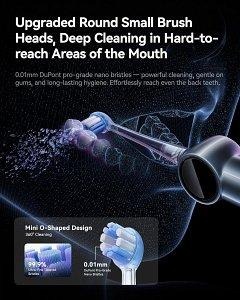
In the AirJet system, interdental cleaning is handled by cavitation, not bristle speed. The bristles are responsible only for surface polishing — a task that does not benefit from extreme frequencies. This frees the mechanical design to prioritize gum safety: a 21,600-stroke ceiling, a tight 12° oscillation arc, 0.01 mm bristle tips with a 99.99% end-rounding rate, and a thermoplastic elastomer backing that absorbs stray vibration.
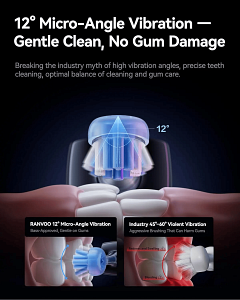
The result is a device that can claim Grade 1 cleaning efficiency — the highest standardized classification — while running quieter and gentler than most premium competitors.
The Modes Aren’t Timers
Many electric toothbrushes offer multiple “modes” that adjust nothing more than the two-minute timer segmentation. The AirJet X5 takes a different approach: each of its four modes is defined by four independently set parameters — vibration frequency, liquid flow rate, oscillation amplitude, and sweep angle.
- Bubble Mode: 15,600 strokes/min, 1,000 ml/min flow, tight 1.2–2.5 mm amplitude. Maximum interdental cavitation. The signature experience.
- Sensitive Mode: 15,600 strokes/min, 500 ml/min flow, wider 3.0–4.5 mm amplitude. Reduced fluid pressure for gum recovery periods.
- Clean Mode: 21,600 strokes/min, 800 ml/min flow, narrow 0.5–2.2 mm amplitude. The everyday balance.
- Whitening Mode: 18,500 strokes/min with alternating dual-frequency, 1,000 ml/min flow, 2.5–4.5 mm amplitude. Targeting extrinsic stain.
A 0.79-inch TFT display on the handle provides at-a-glance mode feedback, battery status, and a quadrant timer with 30-second zone prompts.
The Engineering of Storage
RANVOO appears to have thought as carefully about what happens when the brush isn’t in use as when it is.
The included magnetic wall mount integrates wireless charging, eliminating the countertop charging puck that accumulates water and biofilm at its base. Vertical storage allows gravity to drain moisture away from the handle. Open-air exposure on all sides enables complete drying between sessions — a detail that matters for long-term hygiene in a humid bathroom environment.
Both the ABS handle and the ABS+PC mount carry a silicon carbide (SiC) anti-mold coating, certified to Grade 0 — the highest classification in mold-resistance testing. The handle itself is IPX7-rated, submersible to one meter for 30 minutes.
Battery life is rated at up to 39 days from the 1,600 mAh lithium-ion cell. Charging takes approximately six hours via USB-C or the wireless dock. Operating noise stays at or below 65 dB across all modes.
What It Means
The AirJet X5 is a product that makes more sense the longer you examine it. Its core thesis — that bristles are the wrong tool for the most clinically important cleaning task — is difficult to dispute once you look at the anatomy. Its solution — microbubble cavitation guided by fluid dynamics — is grounded in well-established physics, not marketing invention. And its surrounding design choices — the low-frequency approach, the independent mode parameters, the wall-mounted charging architecture — reflect a coherent product philosophy rather than a feature checklist.
At 20 granted patents, the intellectual property position is substantial enough to make this more than a one-off experiment. RANVOO appears to be building a platform, not just shipping a device.
Whether consumers are ready to rethink what a toothbrush is remains an open question. But the AirJet X5 makes a compelling argument that they should.