Today, AI is already the standard for business rather than a feature that sets companies apart from their competitors. The AI landscape is changing rapidly, forcing companies to choose between two powerful technologies: AI agents and chatbots. The global AI agent market is projected to grow to $236.03 billion by 2034. As a result, choosing the right solution has become critical for business growth and success. In this article, we’ll discuss in detail the importance of AI solutions such as chatbots and agents, and explain the difference between them so you can clearly understand which solution is best suited for your business.
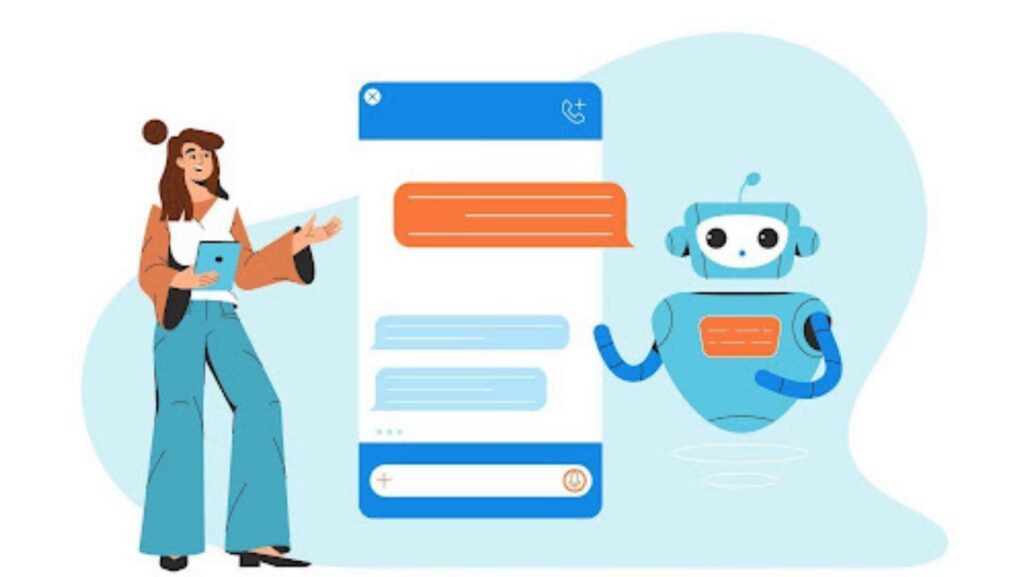
Modern chatbots help companies automate customer interactions, speed up operations, and reduce the workload on staff. It is a program that replaces a customer service representative when communicating with users regarding routine and frequently repeated tasks. Such a business chatbot can instantly answer specific questions from a database of responses and react to predefined commands.
As a rule, chatbots are used in routine situations that often take up a lot of a human’s time. At the same time, the tasks that a chatbot handles aren’t all that simple. The most common capabilities of business chatbots include:
- Resolving common customer or user issues
- Assisting with service selection
- Suggesting and providing related services
- Answering standard, repetitive questions
The advantage of chatbots is that they are cost-effective, can be implemented quickly, and ensure consistent messaging, which is particularly valuable in regulated industries such as finance. However, their limitation lies in the rigid, predefined responses and the fact that setting up multi-level dialogue flows requires significant time and financial resources.
AI agents are becoming an increasingly popular choice among companies that need automation; that’s why they cooperate with partners that help implement Microsoft Copilot Studio. Powered by large language models and natural language processing, AI agents can understand context and tone, integrate with multiple systems, make autonomous decisions, and continuously learn from interactions. As a result, they can manage complex workflows, solve problems in real time, and personalize customer interactions — thereby increasing satisfaction and reducing operating costs.
AI agents differ from classic bots in their flexibility. A chatbot operates according to predefined rules and does not deviate from them. An agent makes decisions based on the current context, rather than a fixed script. Therefore, it is capable of solving problems where it is impossible to describe all possible behaviors in advance.
A major advantage of AI agents is that the model is trained on real-world data, improving the accuracy and effectiveness of responses; furthermore, AI agents enable continuous interaction with customers without any time or language restrictions.
Many people mistakenly believe that AI agents and chatbots are the same thing, but there is a significant difference between them. Yes, they both automate interactions with users, but they do so at different levels, and their capabilities differ significantly.
The first important point to note is the level of adaptability. Thanks to modern language models, AI agents understand natural language much better, can maintain complex conversations, and can clarify information. This capability significantly reduces the number of instances where a human employee needs to be brought in.
A chatbot, in turn, operates according to a specific script and uses a pre-programmed database of responses. Chatbots are effective for handling typical inquiries, assisting with information searches, or processing simple requests; however, they are not capable of independently performing complex tasks or making complex decisions.
The level of integration is another aspect that differs significantly. While a chatbot typically interacts with one or a couple of services, an AI agent works simultaneously with ERP, CRM, and HRM systems, as well as document management systems, emails, calendars, and other corporate platforms. Thus, chatbots can be used to automate individual responses, while AI agents can automate entire business processes.
Thus, the choice between a chatbot and AI agent is not just a matter of budget, but also a matter of business objectives. A chatbot is the best solution if you need to automate responses to common questions. However, if your business needs to automate complex processes, reduce manual work, and improve employee efficiency, AI agents will be much more effective at meeting these needs.
Chatbots and AI agents share a common goal, but their capabilities differ significantly. It is important for businesses to understand that the choice of technology should be based not only on implementation costs, but also on the company’s strategic goals. For small organizations that need to automate basic customer support, a chatbot will most likely suffice. However, if a company aims to scale its operations, increase employee productivity, and reduce the time required to complete processes, then it is better to consider AI agents.