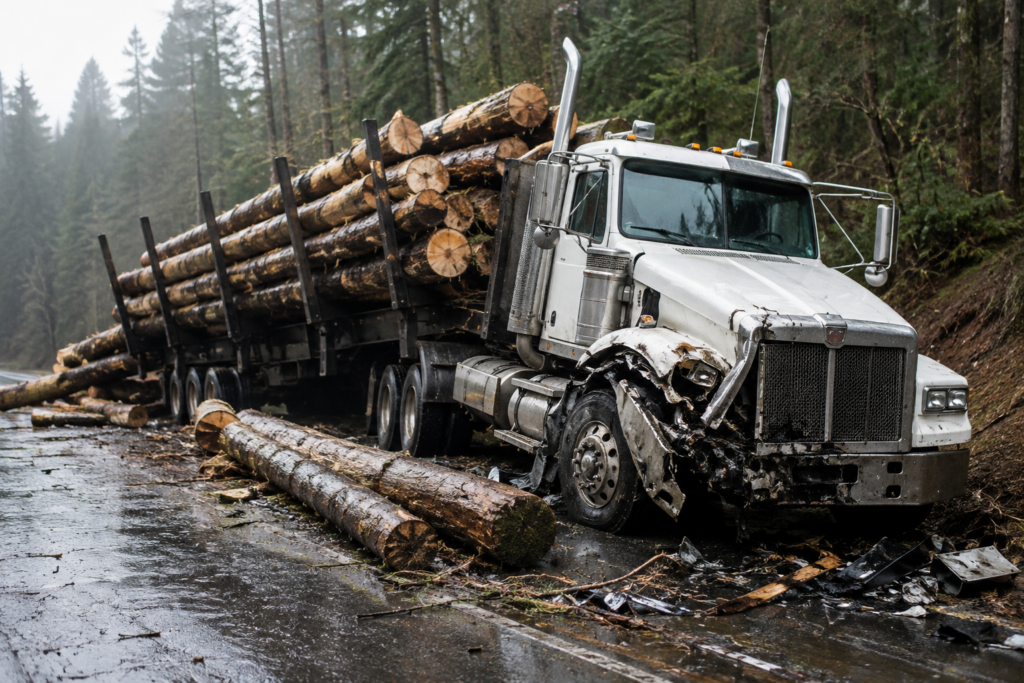
A collision with a timber-hauling truck can leave a person facing far more than vehicle damage. The size and weight of these commercial vehicles can make crashes especially serious, while the circumstances behind the collision may involve cargo loading, vehicle maintenance, driver conduct, road conditions, and several different businesses. For an injured person, the hardest part is often figuring out what actually caused the crash and who should be held responsible. A truck driver may be involved, but the investigation can extend to the trucking company, logging operation, cargo loader, maintenance provider, vehicle owner, or another third party. That is why these cases deserve a careful investigation rather than being handled like an ordinary passenger-car accident. The available evidence can determine whether an insurance claim accurately reflects the losses suffered by the injured person or leaves significant damages unaddressed.
Why Timber Truck Collisions Require More Than a Standard Accident Investigation
Logging trucks operate under conditions that are different from ordinary commercial traffic. They may travel on narrow rural roads, haul heavy timber loads, enter and leave worksites, and operate in areas where curves, steep grades, poor visibility, and changing road surfaces create additional challenges. The cargo itself is another major consideration. Logs must be loaded and secured appropriately so that the weight remains controlled during transportation. A problem with the load can affect the vehicle’s stability or create a hazard for surrounding motorists.
Federal commercial motor carrier rules also address areas such as driver qualifications, vehicle inspection, hours of service, and cargo securement. The exact rules that apply can depend on the vehicle, operation, route, and type of transportation involved. This creates an important legal distinction. Establishing that a crash happened is only the starting point. The investigation must examine why it happened and whether a safety failure by one or more parties contributed to it.
The Most Common Factors Behind Serious Logging Truck Crashes
Logging truck collisions can develop from several connected failures rather than one isolated mistake. A thorough investigation should consider the entire chain of events.
Common contributing factors include:
- Excessive speed for road or weather conditions.
- Driver fatigue or violations involving permitted driving time.
- Distracted or inattentive driving.
- Following another vehicle too closely.
- Unsafe lane changes or turns.
- Improperly loaded or secured timber.
- Overloaded or unbalanced cargo.
- Worn tires, defective brakes, steering problems, or other mechanical issues.
- Inadequate inspections or maintenance.
- Poor visibility, rain, fog, or other environmental conditions.
- Dangerous curves, steep grades, potholes, or inadequate roadway design.
- Insufficient driver training or supervision.
The presence of one factor does not automatically establish legal liability. For example, bad weather may contribute to a collision, but that does not necessarily excuse a driver who was traveling too fast for the conditions. The same principle applies to mechanical problems. A failed component may point toward a maintenance issue, a manufacturing defect, or another source of responsibility. The evidence has to establish the connection.
Liability Can Extend Beyond the Truck Driver
One of the most important aspects of a logging truck claim is identifying every potentially responsible party. The driver may be liable when careless operation, speeding, distraction, fatigue, or another negligent act caused the collision. However, the driver’s role is only one part of the investigation. The trucking company may face responsibility depending on its relationship with the driver and the circumstances of the crash. Questions can include whether the driver was properly trained, whether required inspections were performed, and whether company practices encouraged unsafe driving.
A logging company or cargo-loading operation may also become relevant when improper loading or inadequate securement contributed to the collision. A maintenance contractor could face liability if negligent repairs or servicing contributed to mechanical failure. In some circumstances, the truck, trailer, or component manufacturer may also become relevant if a defective product played a role. This broader liability analysis matters because commercial transportation claims can involve multiple insurance policies and separate corporate entities. Identifying only the driver may leave important evidence and potential sources of compensation unexplored.
Evidence Can Tell the Story the Insurance Company Does Not
After a serious commercial truck collision, physical evidence and records can become extremely important. An investigation may involve photographs of the crash scene, vehicle damage, skid marks, road conditions, cargo positioning, and the truck’s mechanical components. Investigators may also examine police reports, medical records, witness statements, surveillance footage, and available electronic data. Commercial records can provide another layer of evidence. Depending on the circumstances, relevant materials may include driver logs, inspection reports, maintenance records, dispatch information, cargo documents, loading records, employment records, and communications concerning the trip.
For a Logging truck accident attorney, reviewing these records can help determine whether the collision resulted from driver negligence, cargo problems, mechanical defects, inadequate supervision, or a combination of factors. Evidence preservation should also be treated seriously. Some information may exist only temporarily, particularly electronic recordings or data maintained by third parties. Early legal action can help protect relevant evidence before it disappears, gets overwritten, or becomes difficult to obtain.
Injuries Can Be More Complicated Than They First Appear
The consequences of a heavy-truck collision are not always fully understood during the first few hours after the crash. Some people initially focus on visible vehicle damage and overlook symptoms that develop later. Medical evaluation is important because serious collisions can produce injuries involving the head, neck, back, bones, muscles, or internal systems. Potential injuries may include traumatic brain injuries, spinal injuries, fractures, soft-tissue injuries, internal injuries, and other conditions requiring extended treatment.
The financial impact can also continue long after the accident scene has been cleared. A person may need emergency treatment, hospitalization, surgery, medication, rehabilitation, physical therapy, follow-up appointments, or long-term care. An injury claim should therefore consider more than the first medical bill. The full impact may involve future treatment, reduced earning ability, property damage, and non-economic losses such as pain, suffering, and diminished quality of life.
How Compensation Is Evaluated After a Logging Truck Collision
There is no universal settlement amount for a logging truck accident. The value of a claim depends on the facts, applicable state law, insurance coverage, severity of injuries, liability evidence, and long-term consequences. Economic losses can include medical expenses, rehabilitation costs, lost wages, reduced earning capacity, property damage, and other documented financial losses. Non-economic damages may address physical pain, emotional distress, limitations on normal activities, loss of enjoyment of life, and other consequences recognized under applicable law. A useful way to evaluate a claim is to separate immediate losses from future losses.
|
Category |
Examples |
|
Medical costs |
Emergency care, hospital treatment, surgery, medication |
|
Rehabilitation |
Physical therapy, occupational therapy, follow-up care |
|
Income losses |
Missed work, reduced earning ability, career limitations |
|
Property losses |
Vehicle repairs, replacement costs, damaged personal property |
|
Future expenses |
Continuing treatment, assistive services, long-term care |
|
Non-economic losses |
Pain, suffering, disability, reduced quality of life |
Insurance limits can also affect the recovery process. Commercial trucking operations may have significant coverage, but the available insurance depends on the parties involved, the type of operation, and the policies in force.
What Makes a Strong Claim Different From a Weak One
A strong claim is not simply a claim involving severe injuries. It is a claim supported by credible evidence connecting the defendant’s conduct to the losses suffered. That means documentation matters from the beginning. Medical records should clearly establish the nature and progression of injuries. Employment records can help demonstrate income losses. Photographs can preserve evidence of vehicle damage and road conditions. Witness information may become valuable when accounts of the collision differ.
A detailed investigation can also expose inconsistencies between the initial insurance narrative and the available evidence. For example, an insurer might characterize a collision as an unavoidable roadway incident. A deeper investigation could reveal that the truck was traveling too quickly for a sharp curve, had a maintenance problem, or carried an improperly secured load. The distinction can significantly affect the legal analysis.
What to Do After a Collision With a Logging Truck
The immediate priority after a serious crash is personal safety and medical attention. Once emergency needs are addressed, preserving useful information can help protect a potential claim.
Important steps include:
- Seek medical attention and follow the treatment plan provided by healthcare professionals.
- Report the collision to the appropriate authorities.
- Photograph the vehicles, roadway, traffic conditions, and visible damage when it is safe to do so.
- Obtain contact information from witnesses.
- Keep records of medical treatment, expenses, missed work, and related losses.
- Preserve relevant photographs, messages, documents, and insurance information.
- Avoid making statements that speculate about fault.
- Be cautious about giving recorded statements to an insurer before understanding the claim.
- Consider speaking with a qualified truck accident lawyer about the circumstances.
The purpose is not to complicate the process. It is to make sure important evidence and information are not lost while the physical and financial consequences of the collision are still developing.
The Investigation Process Should Follow the Evidence
A professional truck accident investigation should begin with the collision itself and then work backward through the factors that made it possible. The accident scene may reveal vehicle positions, road characteristics, visibility, traffic patterns, and physical evidence. Vehicle inspections can reveal mechanical conditions that are not obvious from photographs.
The cargo investigation can be equally important. Investigators may need to determine who loaded the timber, how the load was secured, whether the weight was properly distributed, and whether the equipment used for securement was appropriate. Driver records can provide another perspective. Depending on the case, attorneys may examine qualification records, training materials, inspection documents, driving history, hours-of-service information, and company policies. The goal is to build a factual timeline rather than rely on assumptions.
State Law Can Change the Outcome of a Truck Accident Claim
Truck accident claims are governed by the laws applicable to the location and circumstances of the collision. Rules concerning negligence, comparative fault, damages, insurance, wrongful death, and filing deadlines vary from state to state. That matters when an injured person is considering legal action.
A deadline may apply to filing a lawsuit, and different rules may apply when a government entity, employer, or other specialized defendant is involved. Waiting too long can also make evidence harder to obtain. Because of these differences, general information cannot replace advice based on the specific jurisdiction and facts of a particular collision.
Choosing Legal Help for a Serious Timber Truck Collision
Not every truck accident case requires the same legal strategy. A straightforward claim involving clear liability may be handled differently from a collision involving disputed fault, multiple companies, cargo problems, serious injuries, or significant future losses. When choosing an attorney, look for experience with commercial vehicle litigation and cases involving serious personal injuries.
Ask how the firm investigates trucking records, identifies potentially responsible parties, handles insurance negotiations, and prepares cases when settlement discussions do not produce a fair result. A good attorney should also explain the process clearly instead of making unrealistic promises about the value or outcome of a case.
Conclusion
A collision involving a timber-hauling truck can create a complicated legal and financial situation that extends well beyond vehicle repairs. The size of the vehicle, the nature of its cargo, commercial transportation rules, rural road conditions, maintenance issues, and relationships between different companies can all affect how responsibility is determined. The most useful approach is to focus on evidence. Understanding how the crash happened, identifying every potentially responsible party, documenting the full extent of the injuries, and preserving important records can make a significant difference in a personal injury claim. If you or a family member has been seriously injured in a logging truck collision, obtaining advice from a qualified attorney in the appropriate jurisdiction can help clarify your legal options and the evidence needed to pursue a claim.